Picture in your mind a production line manufacturing widgets, a packaging and sorting facility, the training stages before you qualify for a promotion, the structure of courses to earn an accredited diploma. What do they all have in common? Rigid standards that may be state of the art one day, yet persist long after better alternatives come along.
We all know the anecdote that, depending on the dosage, a medicine can cure or kill a patient. The same principle applies to processes and standards. However, in this case it’s not the dosage, but the inflexibility about change.
But not for change’s sake. That in itself is not a good enough reason to justify making things different. You must have a solid explanation, and it must be able to stand on its own when challenged.
Change comes with a cost to the company, to its customers, and to secondary markets. Everyone will pay a price to adopt the change, so it better justify itself. Otherwise it will only cause unnecessary turbulence.
But I Know How To Do It Better
Those with professional experience who then move into management, either via a promotion or by starting their own businesses, often establish processes to do things the best way they know. There are several advantages to doing this: it saves time, shortens the work, avoids known mistakes, and gets into production sooner. This also means that the process is the best it will ever be. “We do it like this because that’s how it has always been done” is a real syndrome and has captured many a company within its inescapable jaws.
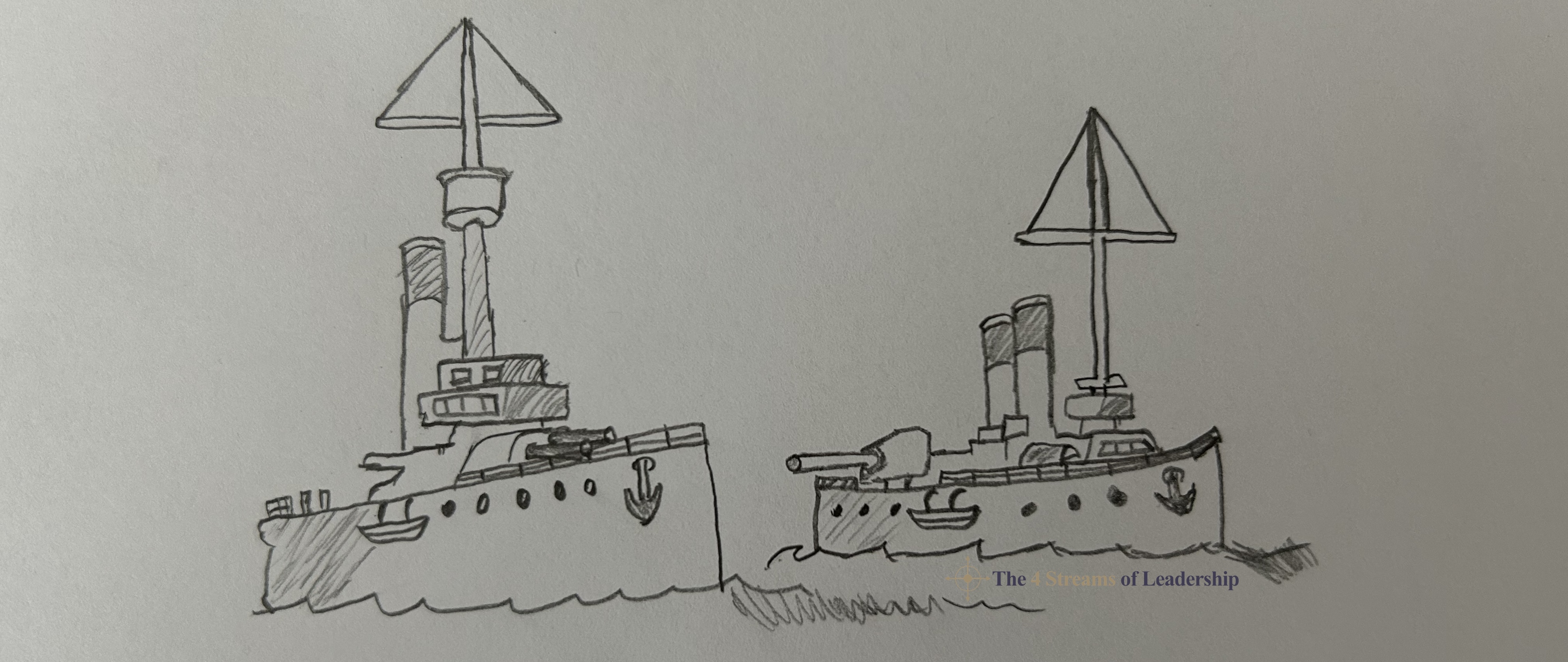
Take for example the events at the turn of the 20th century, when aiming and hitting the target with naval guns was nearly impossible for lack of a mechanism to account for the roll of the ship.
The miss rate was stratospherically high at a target practice exercise in 1899, when five ships of the North Atlantic Squadron each fired for five minutes at a lightship hulk at 1,600 yards. After twenty-five minutes, experienced gunners scored only two hits. Yet, the ranking of officers in the British and U.S. Navies was dependent on artillery training. That meant promotions and entire careers were directly linked to a rigid process of operating an inefficient weapon.
English Captain Percy Scott proposed and demonstrated a change in the gear ratio to allow a gunner to raise and lower the gun fast enough to keep up with the ship’s roll, and placed the aiming telescope on a sleeve that would stay static despite the recoil. Later, American Lieutenant William Sims learned the methods from Scott and retrofitted the guns on his own ship.
Despite sending numerous reports to Washington, Sims faced fierce resistance from within. The cost of changing fell on the livelihood and ranks of countless Navy members. It took Sims the determination to cut through the bureaucracy and through many layers of hierarchy until he reached President Theodore Roosevelt, who understood that naval superiority was critical for national security. Roosevelt gave a direct order to implement the changes and made Sims Inspector of Target Practice.
There are no villains in the story. Each side had a defensible perspective. One side knew that retooling the guns, retraining crews, and revamping the ranks of officers came at a steep cost. The other side knew that the changes were necessary. Failing to do so would cost even more. If an unfriendly nation were projecting force with such superior weapons, the country would be incapable of deterrence and at a serious disadvantage in the event of an escalation.
The bureaucracy’s mistake was to use the existing standard as the test of the method meant to replace it.
On the other side of the spectrum, there are software companies that, too frequently, change their user interfaces, imposing a cost on all their users, without a good reason for why the change was necessary and how it helped. The outcome is familiar: infuriating users. But because of the sunk cost of the body of work already in the system, and the cost of changing platforms being often prohibitive, customers remain customers.
There are also extreme outliers, things that shouldn’t change due to impossibly high costs, no sane explanation to justify them, or any possible benefit to show for. For instance, which side of the road to drive on.
Change as an Engineering Problem Frequently Falls Flat
Attempting to frame change as an engineering problem fails more often than it succeeds. Engineering will optimize to make a metric comply with the expected results. Plan the metric to go up and the incentives will make it rise; set it to go down and the incentives will make it fall.
Amidst a rapid expansion, the largest home improvement retailer in the U.S. implemented several needed and rational optimizations for operational excellence, such as centralized buying to negotiate better prices with suppliers. However, they went too far and took away stores’ ability to fine-tune for regional markets (e.g., home insulation in Alaska and sun-resistant paint in Texas). They also cut experienced people who knew how to teach customers and replaced them with regular associates. Revenue went up, but sales per store remained flat. A few years later, realizing that some of the changes weren’t working, they changed the CEO and reinstated some old practices.
Change is about challenging a fundamental premise that no longer applies. A propeller will never cruise where a jet turbine does; a vacuum tube will never be as small or as reliable as a transistor; a horse and buggy won’t ever go as fast and as far as a car; a ballpoint pen is far more convenient and reliable than a quill. In all those cases, a fundamental change took place.
The Attempt To Give Change a Purpose
Numerous justifications have been offered to support change: technological shift, defending against the competition, savings in production costs, simpler operations, and so on. The trap is the illusion that replacing an explanation for why with a metric to be achieved will yield the same results. Change in itself does not translate into betterment.
A Case For Standardization
The point of establishing a process, and of standardizing how things are done, is to get reproducible results once something scales past a certain critical threshold. A single master carpenter cannot craft hundreds of pieces of furniture per day and a mechanic cannot build a car per hour.
By establishing a process, you create the blueprint for training people and machines to get consistent, repeatable results. That allows the whole system to grow. Economies of scale follow, such as the ability to negotiate better prices with suppliers, reduce distribution costs, and serve many more customers.
The friction will always be at the point where you’re responding to change. Sometimes the answer will be “yes,” other times the answer should be “no.” And although there is no guaranteed recipe for determining what is what, your chances of being right will be better if you can explain—without fooling yourself—why a change is necessary.
There are a few things that you can do if you are uncertain or need to test a hypothesis:
- Roll out changes to a small percentage of customers. You can invite customers to be early adopters, or those who are open to experimenting with new features. Participation is voluntary and often offered with some kind of benefit such as a price discount.
- Release a new version without deprecating the old one. Car companies release new models while maintaining the previous ones for years to come. Some software companies operate similarly with their cloud and downloadable products.
- Release a new product together with a marketing campaign that clearly explains why the change was necessary, how the new version is superior, and when the investment justifies the costs. Large consumer electronics companies tend to do this, and for them there are high-risk costs involved such as the cost they are imposing on customers, the cannibalization of their own product lines, and the losses on old inventory.
The context of change matters, just like most things in life. This is a tremendous challenge and requires a close collaboration between leadership (to identify and decide on the changes) and management (to effectively implement the changes).
Without standardization, your company will face problems with wide quality variations, tolerance deviations, and vastly different customer experiences.
Lack of process standardization is a worse model. But when too rigid, standardization can backfire and prevent your company from evolving with the times. The challenge is to discern between reproducibility and ossification. Wisdom comes from the ability to explain the why or why not.




Leave a Reply