Why Popularity Compounds, People Cheer for the Wrong Bet, and Climbing the Ladder is Cutthroat
Here’s something for you to try: watch what people choose after they saw what others chose already. There is a good chance they will either copy others or seek suggestions on which option to pick. If something gets attention, that is seen as proof that the thing deserves attention. The more it gets, the more it attracts. Why does this pattern repeat time and again among humans and animals?
In network parlance, this phenomenon is called Preferential Attachment. It basically means that the probability of something becoming more popular grows with the popularity it already holds. At times, it can feel like a system that feeds on itself. In fact, it doesn’t.
Its mechanism is deceptively simple, yet it leads to extreme results. Standing out in a small way can transform into an almost attention monopoly, even if comparable or better alternatives are available. And most of the time, you won’t even notice.
Guppies, Celebrities, and the Must-Watch Show
Put a few guppies in an aquarium, and soon, the few males that draw the interest of a female will look more attractive to almost all other females. And they will keep gaining more suitors, while the other males remain largely ignored.
When a new singer releases a song, the early listeners are almost random. Then a DJ, promoter, or well-timed marketing boosts the track and more people get to listen to it. Each new play increases the chance of the next one, as word-of-mouth and algorithmic selection make it even more popular. Once it gains momentum, the popularity has less to do with the quality of the song, and more with what people see as the preference of others.
TV shows work the same way. A new series may start with modest viewership numbers, but soon everyone is talking about it and it becomes the must-see show of the season. How good the show is takes a backseat to whether you’ve seen it. The popularity of similar shows in competing platforms pales in comparison.
Status Games
Status is a rank in the eyes of others, and a lot of preferential attachment is a status game. Players of these games want recognition, credit, respect, consideration, adoration, and more, much more. Once something is deemed as high status, others flock around it to borrow prestige, signal belonging to a group, or gravitate near power. And the system compounds on itself—both for the utility of the thing and for the association factor boost in standings.
But before developing animosity toward status games, there are no villains here. The games become negative only when playing them is the only objective that matters.
Status games done right are a mechanism for learning. You can experiment with concepts by copying others in ways such as reading a recommended book, dressing in the latest fashion, visiting a location, and so on. Imitation can help you discover things you like, and things you don’t like. The important bit is being aware of how you play the game. Those without mentors and those who had a deficient education often build a curriculum of their own by deliberate copying.
Beware that the games are also merciless. The moment preferential attachment ceases, the fall from grace is immediate. Who still clings to the silent-era movie stars, last year’s hit song, or the hot brand of clothes to wear in middle school?
Placing the Wrong Bets
Organizations are networks of departments, people, and customers. It is inevitable to find preferential attachment to be an integral part of the system. People compete for it, protect it, and copy whoever already has it. Project assignments, promotions, time speaking in meetings, and mentorship all follow the pattern.
Over time, the gains compound. Those with early preferential attachment accumulate allies, narrative control, and opportunities. Latecomers tend to face a steep climb, even when the quality of their results is better.
The climb is cutthroat because the higher you go, the more competitive the opportunities become, and the better-prepared the contenders. Also, late competence faces walls and obstacles that weren’t there for earlier climbers.
The person already seen as a high performer tends to be assigned to more visible projects, get more recognition for a job well done, and go up the corporate ladder faster. Competence still matters, but it can get diluted by other signals.
When the goal of a leader is to gain status, instead of making the best decision, they accelerate a train wreck. Budget, praise, and support are given to those with high social credit or those who complain the loudest (suppressing dissent is part of the game). Although those might well be the right bets, preferential attachment alone sets a lousy standard for making a decision. Sadly, many get away with it because charisma, although a horrible yardstick, is easier to defend in a popularity contest. But it comes at the expense of mortgaging the company’s future. As they say, the chickens come home to roost.
Again, charisma or popularity aren’t the culprit, but the lack of standards to evaluate decisions is. Without distilling decisions to what really matters, social butterflies who never miss a hallway conversation will be favored over those who shipped products or helped customers adopt a new feature and gathered valuable feedback to make it better.
Those who lose sight of what matters soon discover that people stop taking initiative and no longer work on the stuff nobody asked for. Work will get done by direct assignment only.
The responsibility of setting the rules of the game lies solely on the leader of the organization. This is part of defining what happens when you’re not in the room (i.e., the culture of the place). Fail to establish that and you will face performative emotional theater, avoidance dressed as safety, and demands that all decisions leave egos intact. Merit becomes the first casualty, as it becomes optional. And the irony: a team that will feel good about themselves, despite living an illusion.
The Nuts and Bolts
The concept of preferential attachment first appeared in 1923, and since then it has been studied by many, from György Pólya to René Girard and Robert Merton. In 1999, Albert-László Barabási and Réka Albert proposed the Barabási-Albert Model, which is largely used today.
They proposed a scale-free model defined as an undirected network graph that starts with a few nodes, where is the number of initial nodes. The connections among them are chosen arbitrarily, as long as each node has at least one connection . The degree of a node, represented by , is the number of connections it has.
For each new node added to the network, it can choose to connect with up to other nodes, provided that the number is less than or equal to the starting number of nodes in the network .
Now the interesting part. The probability that a new node will pick any other node to connect to is proportional to the number of connections the prospect node already has. More formally:
Where is the degree of the prospect node and is the total degree of the network.
Look at the evolutionary sequence of the graph below. It starts with nodes A and B , then node C is added. It can choose to connect with other nodes. In this case, C connected with A and B. In the next step, D connected with 2 other nodes, A and C, and so on.
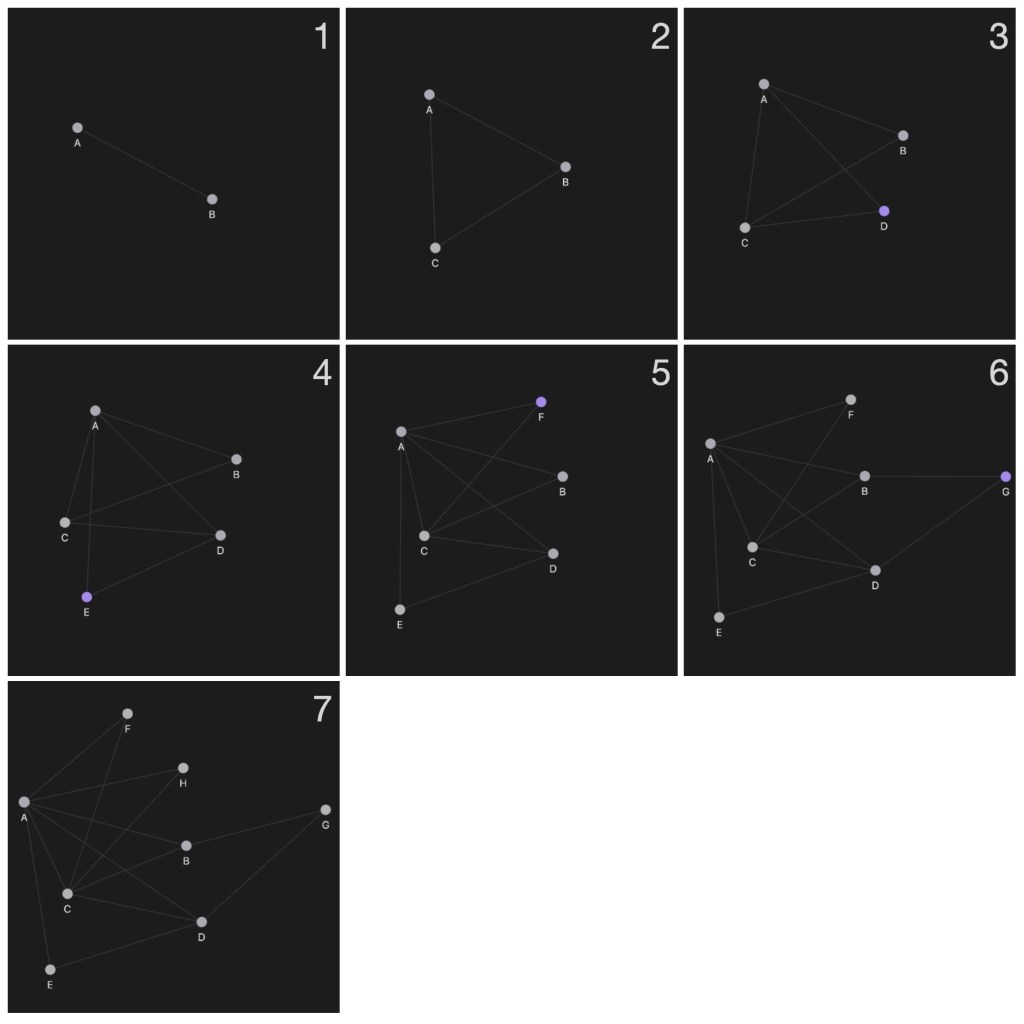
It is easy to see that node A became the preferred one to connect to. For instance, the probability of node H choosing to connect to node A in the last step was:
Where .
There was nearly a 25% probability that H would pick A. Not surprisingly, it did.
A noticeable consequence is that most nodes of the network will have only a few connections, while a small number of nodes will have a large number of connections, turning themselves into hub-like nodes.
Win the Game
Naval Ravikant famously said play stupid games, win stupid prizes. He is right. But notice his emphasis is on stupid games, not that you shouldn’t play any games. At the very least we’re all playing the game of life.
Preferential attachment is part of human nature and can be neither suppressed nor abolished. It emerges naturally from growth and visibility. But you can be deliberate on what you track. Doubling down on a strategy that is working is far from being foolish.
Define and measure effectiveness, not vibes. Effectiveness is the amount of output that meets requirements. A charismatic salesperson who is bringing in customers or a sympathetic manager who works with their team to ship a new product are both being effective.
Be it in nature, society, or companies, preferential attachment will create hubs. In leadership it compounds into excellence or theater, depending on the rules and rewards you set. Be deliberate on what you choose.




Leave a Reply