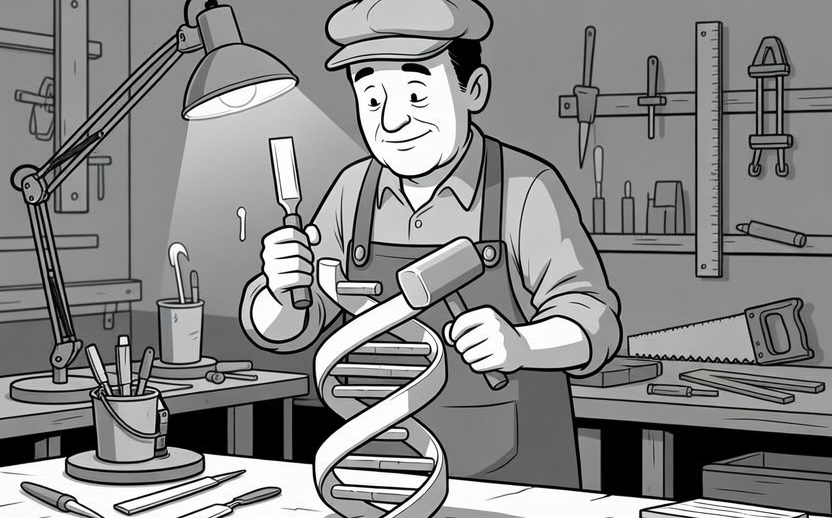
In the core of their DNA, apprenticeships and processes share a goal: reproducible results.
People praise the timeless rituals of apprenticeships, where a craftsman’s knowledge is passed to trainees over years of guidance, until they achieve mastery. The same people often disdain processes as rigid and soulless. Yet both approaches exist to deliver consistent outcomes. The distinction boils down to time invested and depth of understanding achieved. These differences, however, are meaningful and serve different purposes.
The Origins
Since the 1820s, the workforce began receiving education [1] to understand more abstract and complex concepts. Industry and commerce needed workers able to handle operations such as machinery, bookkeeping, and office technology.
Now that employers had access to trained workers, they began establishing rules and procedures for completing tasks and had reasonable expectations of compliance without looking over someone’s shoulders (i.e., micromanaging). From an employer’s perspective, knowing how and when to complete tasks is good enough to guarantee results without every person needing years of in-house training.
But this approach leaves workers lacking a deeper understanding of why procedures were put in place and what problems they solve. This limits contributions to improve the process. Worse yet, suggestions are often ignored, because although well-meaning, they are based on incomplete information.
In contrast, apprenticeships are taught and practiced over a long stretch of time, often years. Trainees gain deeper understanding; they are able to explain a process to any level of details, including the reason why it is necessary and what problem it solves. Thus, they are better prepared to challenge old ways, simplify, and make improvements. The best students often become the teachers.
Tous Pour Un, Un Pour Tous
Are apprenticeships good and processes bad? Not so fast.
Apprenticeships do not scale fast enough to run a business. A company exists to serve customers by delivering a product or service and stays alive only if it earns a profit. How can a business grow and reach more customers at the slow speed of apprenticeships?
The apprenticeship approach limits expansion, but processes codify steps into repeatable instructions and provide a shortcut that approximates mastery well enough to deliver consistent results at large scale.
Processes earn antipathy for multiple reasons, but primarily due to two motives: bloat and lack of understanding. It’s common for new requirements to piled on after a mishap such as a bad product release or a service outage. Many managers respond by instituting burdensome new steps, disregarding second-order side effects (e.g., productivity hit, unspoken accusation of incompetence). It frustrates equally to be told to do something just because “that is how it’s done.” But here’s the catch: the responsibility of learning and understanding is yours, not your manager’s.
The role of managers is to optimize operations to maximize output, and senior leaders will choose to invest their time training only those they see as high-potential individuals. You must be the one showing curiosity and results to earn the investment.
Many argue for companies to abolish processes, claiming they create anti-meritocratic bureaucracy. Yet merit demands reproducible results. Without standardized procedures, the quality curve will resemble a roller-coaster with peaks and troughs. Ignore apprenticeship and the organization becomes brittle. Dismiss processes and the business can’t scale.
Reconciling the differences between apprenticeships and processes is straightforward. In practice both approaches are necessary and serve essential roles. One for delivering consistent results at scale, the other for deep understanding. They form a harmonizing duality, each incomplete without the other.
References
[1] https://www.americanheritage.com/1821-one-hundred-and-seventy-five-years-ago




Leave a Reply