
“No good deed goes unpunished.” In the context of professional careers, this ironic phrase is the impression many describe feeling when a situation is rewarded with more work and without a corresponding match in compensation or job title. But is it the whole story or is there more to it, yet people tend to hyper-focus on one branch in a tree of possibilities?
Before we go any further, let’s take a moment to talk about the expectations for a promotion. Some see a promotion as the outcome of a job well done, but this view is incorrect. Doing a job well is rewarded with a raise, bonus, stocks, and so on. It is the financial recognition to reflect quality work at a person’s professional level. On the other hand, a promotion is given to someone who already and consistently operates at the next level in their career. Therefore, it is a lagging indicator of a person’s performance.
There are other constraints to be considered, such as budget, headcount availability, and so forth. There are numerous instances of a person who is operating at the next level being deserving of career advancement and yet doesn’t get promoted. Although not ideal, a question worth thinking about is: should a person be denied the opportunity of operating at a higher level because of a constraint such as lack of budget that does not allow for a promotion at the moment?
Sadly, there are those who exploit this situation to their own advantage, moving the goal post or making up shameful excuses to deny compensation or promotion. That is unethical and if that is your case, consider changing organization or company; working for such people is a losing proposition. This essay, however, addresses the legitimate cases of what otherwise feels like a “performance punishment.”
Choice
Assuming your manager is morally right and that you work for a good company, what are your options?
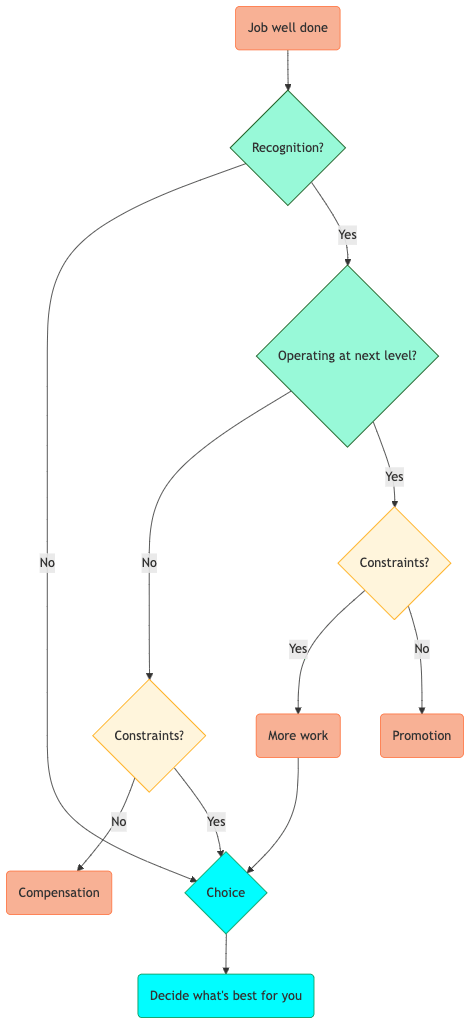
When push comes to shove, you may not be in a position to make a hard decision, but you will always have the option to consider your choices for when the moment is right. Even if your circumstances are not favorable at the moment, conditions may change in the long run, giving you more latitude and agency.
Whatever you choose, approach this decision-making with second-order thinking:
- Consider the long-term consequences, rather than just the immediate outcomes.
- Choose wisely, since you are the one living with the outcomes of the decision.
- Once you decide, commit to it. Avoid falling into traps such as “the grass is greener on the other side,” or “a counteroffer for you to stay.” Those pitfalls seldom deliver on their promises and often leave a bitter taste behind.
Opportunities
I will take the less traveled path of the debate and argue that opportunities present themselves in different ways, shapes, and forms, and that, often times, what on the surface seems to be more work given to you without recognition is in fact a new opportunity presented to you for a later recognition.
For example, Kelly Johnson, one of the most legendary directors at Skunk Works, told Ben Rich that he wanted to make him his successor in the company, but that Rich had to stick around and learn more before the transition could take place. It would be a few more years before Rich took the helm from Johnson, whilst already operating at the next level.
Another case is Bob Taylor from Xerox PARC, who was hired as an assistant director with the dual mission of being the interim leader and to hire the director for the team. He did hire a director, but he was the de facto leader of the team. Later he also became the director.
In the midst of it
In addition to the workload, recognition, and compensation, this essay reflects my own personal experience, one I am still going through as of this writing. In November 2024, my company underwent a major reorganization, and as a result I was given more responsibilities and tasked with more work, without the matching rewards.
My choice was to trust my upstream management and to embrace this change as an opportunity to make a difference in an area of vital importance to the company. Having inherited teams overwhelmed with responsibilities and tasked with delivering the unachievable, the tide has begun to turn and the light at the end of the tunnel is becoming visible.
Far from telling you what to do, this essay presents a basic framework to help you with second-order thinking, and to evaluate your options or lack thereof. The choice I made was based on what was good for me. Your choice ought to be what is best for you.




Leave a Reply