Assume you’re debating whether to skip steps in a release process to hit a customer deadline. Then you discover that there is an existing framework to fast-track it, tests and all, rather than winging and hoping for the best. Sound familiar?
Whether you’re developing a product, designing a new part, or launching a campaign, there is usually a pattern like: idea proposal, approval, prototype, tests, review, release, monitoring. If you had to figure this out from scratch every single time, as if it’s your first day on the job, that’d drive you nuts. Sure, once in a blue moon you might rethink the whole thing, but not all the time. There are huge costs associated with refactoring (e.g., retraining people, updating documentation). Instead, it’s more productive to create a template process (i.e., a framework) so you’re not reinventing the wheel every time you need one.
The purpose of a framework is not to be a checklist. It’s about reproducing the delivery of results in a consistent and reliable manner. It’s also how you train people, rookie or veteran, to run the same processes, meeting expectations while maintaining quality.
But when you’re presenting the framework—maybe in person, maybe online—someone poses a question: “But what if <insert obvious exception>?” Here we go again.
Why frameworks matter
Before we unpack that question, let me share a quote with you:
“Pointing out obvious exceptions implies that either the target isn’t smart, or that you aren’t.”
– Naval Ravikant
Think about it for a moment. This is about seeing the intent in the big picture, rather than nitpicking the edges. With that in mind, why frameworks and when do they need flexibility?
A process is based on a model (i.e., simplification) of a complex system. It’s designed to handle the essentials, be reproducible, and maintain quality. It isn’t meant to address all possible situations, but to cover enough of them that happen on a regular basis, allowing the flow to continue with minimal interruptions.
Even if it were possible to cover all cases within a framework, it’d be impractical to memorize, having to resort to consulting the manual (or an AI system) for each situation, thus defeating the purpose of a framework.
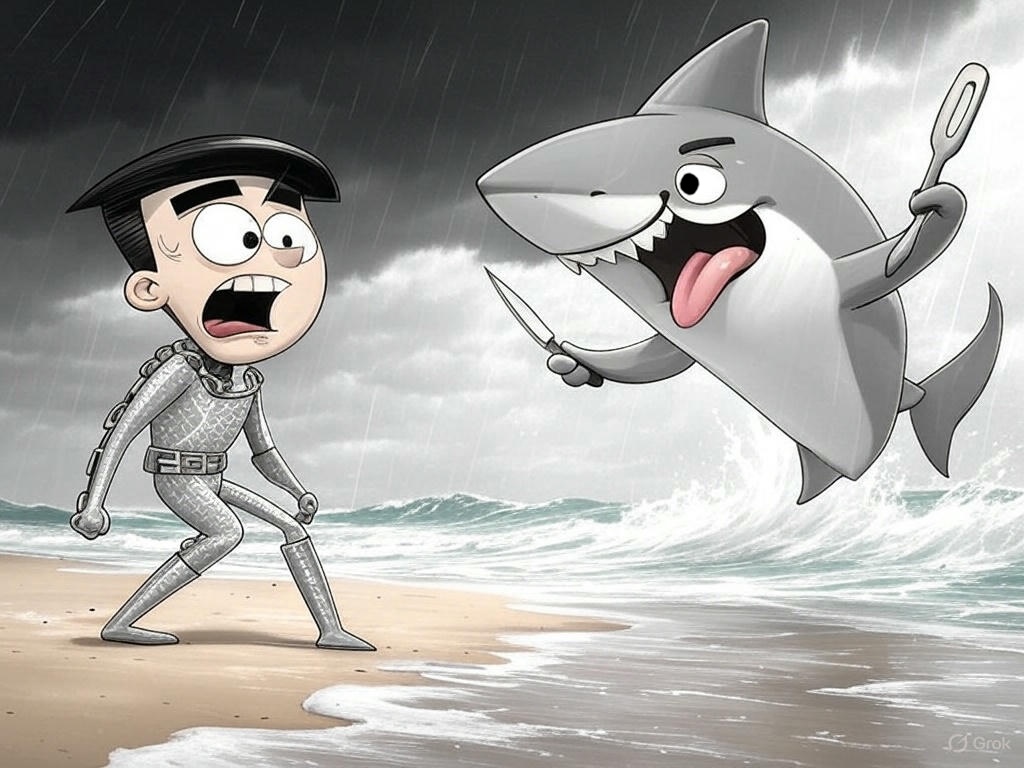
There are also those wild hypothetical questions. What if a Category 6 hurricane starts flinging sharks at us? Shall we all start wearing chainmail shark suits? Realistically speaking, are we designing for reality or sci-fi?
The overlooked “exceptions”
Most of the time, the framework will walk you through the process. Use it until you encounter an exception, then treat them on a case-by-case basis. And by all means, don’t rush to modify the framework to incorporate all exceptions. As the name implies, they are rare. If they’re not rare, they’re not exceptions—they’re an overlooked case. The question now is: should it be codified in the framework?
When truly necessary, amend the framework to cover something that slipped through the cracks, but should have been there.
If your business is truly unique, draft a new framework. You may start by using another framework but then mold it to fit what’s special about your case. But don’t waste time trying to cram all possible cases. That is unrealistic and unproductive. It is feel-good busywork masquerading as real work—an illusion of control. This can be considered procrastination if overdone. Keep your attention where it belongs.
The curious, the well-meaning, and the hecklers
If you think hard enough, of course you’re going to spot an edge case. But what is your motivation? Is it an overlooked case that should’ve been part of the framework? Or are you just poking holes to feel clever in front of an audience? What is your primary incentive?
Some people mean well. They come from a good place, see value in the ideas, and want to contribute, even if their words stumble. Some others challenge you just for the sake of it. Think of the person who starts an argument just to hear himself/herself speak, like in this famous Monty Python sketch.
When addressing those conversations, it is essential for you to stay cool as a cucumber. Then, a good tactical move is to take a step back to assess the situation before responding. Start by assuming good intentions from the other person and go from there. Ask questions such as: “What are your concerns? Where do you see this being used? How often would this happen? What is at stake if ignored?”
Use your instincts to decide whether the question is signal or noise. If the former, help him/her develop the idea. If the latter, cut the oxygen to the conversation.
Handling the conversation well
If someone keeps throwing curveballs at you, they’re likely a heckler. Professional comedians are masters in the art of handling those situations. They have to deal with them on a regular basis, and, as expected, there is a framework for that.
The key is to stay calm and try to turn the situation in your favor, or at least not let it derail you. Here’s a general framework to handle the situation:
- Stay cool: Hecklers thrive on getting a reaction. If you lose your temper, they win. Keeping an even keel is the first step in disarming them and keeping people on your side.
- Acknowledge the person: Pretending he/she is not there might work sometimes, but often it just causes them to speak louder or to post more comments until they’re noticed. A nod or emoji reaction is enough to do the trick.
- Use humor: If you can pull it off, a lighthearted comeback can flip the script—like “Sharks again?” The goal is to put the conversation back on the rails and allow it to continue.
- Judo move: Bring focus back to your point. You might say, “Alright, let’s get back to the topic.” And in a composed move, address the group: “As I was saying…” It shows you’re in control.
- Be firm but polite: If they’re relentless, draw a line. Keep your cool and say something like, “Hey, I’m happy to chat later, but we need to keep this moving for now.” If things escalate out of control, you may need to block the person online, or if in a public setting, hand it off to security.
- Stick to the agenda: Your goal is not to win an argument. Don’t let it mess with your head.
Back to the beginning
Frameworks won’t solve every “what if,” nor should they. They are more than a list to have boxes checked out. They are tools for reliably reproducing results. And when you encounter an exception, decide whether to codify an overlooked case or handle it as a one-off event.
The goal of frameworks is not perfection—they’re about cutting friction from the flow. Take a look at your processes: is there something you can improve today?




Leave a Reply