Clinging to an idea too tightly may define you. If you are a contrarian and are right, that can become a life-changing moment. But what if you’re holding on to an idea that is incorrect?
Being able to let go of an idea and change your mind is a superpower. Some people feel like they must defend an idea no matter what, because admitting being wrong is perceived as a weakness. On the contrary. It is a self-imposed sentence to anchor yourself to a moment in time where your understanding of the world was different.
But what is the right time to let go of an idea, and how do you decide to stick to it?
Imagine this: you’re visiting a friend and ring their doorbell. Half a minute passes and no one answers; maybe they didn’t hear it. You ring it again. More time passes and still no one answers the door. At what point do you accept that there is no one in the house and leave? This is not an exact science, but this concept is equally applicable to sticking to or dismissing an idea.
Assuming that you have skin in the game, the incentive is for you to get it right, because, for better or worse, you’re the one who will live with the consequences of the decision.
In September 2024, I wrote about a fictional boy named Sarl Cagan and how he believed that meteors always fell in the center of craters and developed a hypothesis that if he could stop craters from forming, he would prevent meteors from falling to Earth. When he was confronted with new evidence, he was faced with a dilemma of changing his mind and a thought he held for most of his life. You can read the essay here.
Take the real-life example of Steve Chen. In the 1980s, at Cray Inc., he was the principal designer in building the world’s fastest supercomputers, such as the X-MP, which brought innovations such as shared memory and parallel vector processors (think of shaders in GPUs). But advantages in specialization of supercomputer microchips and architecture were quickly being eroded by commodity microprocessors and hardware architectures. Chen understood the macro change and was able to quickly understand the new reality and changed his mind. In 1987, he left Cray, and in 1988 he found Supercomputer Systems Incorporated.
A few years later, the company closed its doors. Sometimes the early bird catches the worm; some other times it’s the second mouse who gets the cheese. Nevertheless, the concept of using commodity hardware for building supercomputers remains valid to this day.
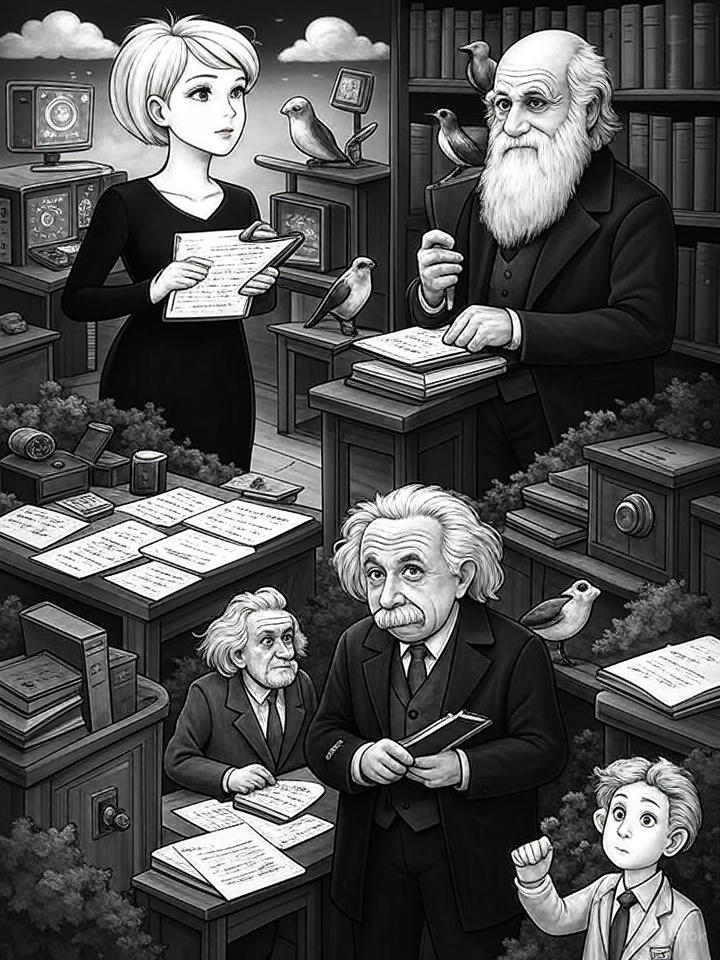
On the other hand, Charles Darwin changed his mind about species being unchanging creations. In the Galapagos Islands, he understood that the ideas of his time were incorrect, and that led him to formulate the theory of evolution. In 1859, he published On the Origin of Species and turned the field of biology upside down, despite fierce resistance.
Albert Einstein experienced both situations. First, he assumed that the universe was static and introduced a “cosmological constant.” Then, when Edwin Hubble’s observations showed that galaxies were moving and expanding, Einstein, in a magnificent act of humility, called his cosmological constant his “biggest mistake.” Second, he understood that gravity was not a force, but a curvature in space. He stuck to his gut and defended his theory until the world came to understand that he was right.
Why this matters to you
These are more than story lessons; they are a necessary mental model for decision-making. Whether you’re managing a team, startup, or a Fortune 500 company. The ability to adjust your mind in light of new information is a trait of great leaders. Tell me a time when you changed your mind or a time you went with your gut feeling. What was the final result?




Leave a Reply